Frame
Reinventing a digital publication's product for scalability and engagement


brief
As a startup journalism publication, Frame was producing innovative multimedia concepts but were unsure how best to scale them.
The challenge was to maintain their identity and product principles while creating a more scalable output.
My Contribution
Led a product redesign through research with the founders, their audience, and into the journalism landscape.
Outcome
Bridging software solutions with a brand refresh and a new UX, we created a Webby-winning article form that gained 20% engagement and reached an audience of 1.5+ million readers globally.
Role
Design Lead
Functions
Product Strategy, UX Research, Product Design, Journalism
Duration
18 months
Publication
Example articles that Frame was previously producing - both animated videos hosted on the web, spawning a few issues:
Not Web Native
Unresponsive Design
Resource Intensive
Challenge
Maintain Frame's core principles while reinventing its product to be both scalable and web native.
Goal
Help Frame launch a refreshed publication bringing to life their editorial vision.
First research directions:
Frame
Frame’s readers
Journalism landscape
Readership trends

Readers were most drawn to Frame's visual storytelling, while noting that news often felt overwhelming or discouraging.
Journalists, meanwhile, looked for more expressive forms of storytelling to engage readers.
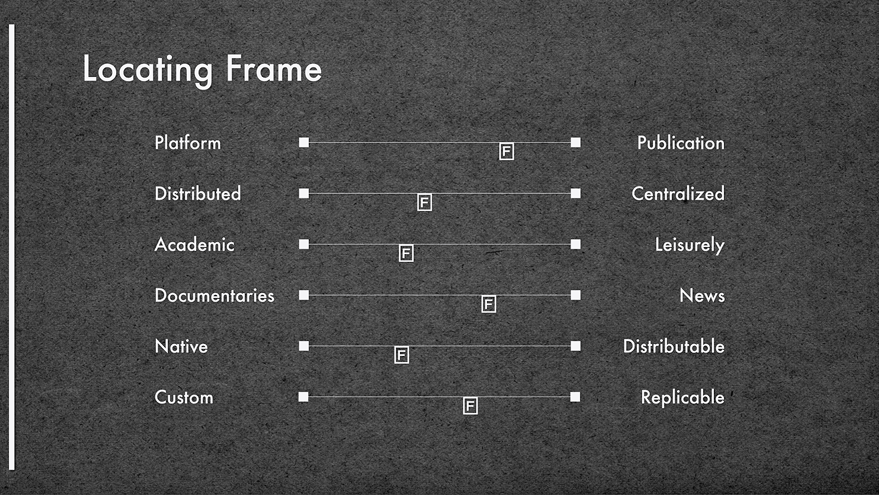
Artifacts from early workshops focusing on Frame's position in the journalism landscape and the founders' vision for growth.
Prioritizing multimedia forms and interactivity, the team sought to develop its own innovations in journalism and technology.
Secondary research highlights:
Reuters 2023 Digital News Report:
- 63% of news readers aged 18-24 prefer to read their news, compared to 18% who prefer to watch
- 56% used a smartphone for news in the last week in 2022, up from 31% in 2013.
- 38% of news readers sometimes or often actively avoid the news, up from 29% in 2017.
"News-avoiders describe news as unpleasant, untrustworthy, and inaccessible."
A few intersections emerged between Frame, its readers, and the wider news ecosystem:
- Readers wanted visual and mobile-first formats, yet still preferred reading to watching - pointing toward opportunity for text-based journalism that was visually rich and optimized for mobile devices
- Frame wanted to be interactive and innovative, and could build its own software solutions - creating space to develop new tools independent of common publishing platforms for custom experiences
- Rooted issues and trends in journalism surfaced, including news avoidance, trust deficits, and accessibility concerns - while systemic issues persist, specific challenges could be addressed through design
Grounding the research:
Emphasize multimedia
Retain Frame’s dynamic and visual style, while refreshing it's branding to become more familiar.
Rethink pages
Create an engaging reading environment leveraging what digital devices do best - layered visuals, motion, and interaction - and add context without spiking reading times.
Progressive disclosure, applied to text.
Addressing concerns from newsreaders
We looked to build an approach combining human-centered storytelling with artful, expressive design to make difficult stories more resonant.
Interactivity became a bridge: keeping experiences concise while offering readers context that made stories feel clearer, more transparent, and easier to follow.
Balancing the above, we built and tested prototypes, refreshed Frame's branding, and developed two connected web apps: one for readers to view articles, and the other for journalists to create them.
Frame's article:


In four different serialized verticals:


Responsive across screen sizes:


Using "Detours" as a core interactive feature:
Created to allow readers to access supplemental context without losing their place in the main narrative, while keeping reading times low.
See how a journalist used one here ➡️


